
New Zealand
Why Corporate Coach Hire Is a Strategic Decision — Not Just Logistics
The way an organisation moves its people is a direct reflection of how it operates. Transport decisions affect time, risk, brand perception, financial efficiency, and employee wellbeing — all of which sit firmly within the domain of strategic management. This article explores why corporate coach hire should sit alongside venue selection and agenda planning as a serious operational consideration, and how managed transport solutions transform travel from a cost centre into a competitive advantage.
The Traditional View: "It's Just Transport"
In many organisations, transport decisions are made late in the planning cycle. A procurement officer or event coordinator sources availability, compares pricing, and confirms the booking. On paper, this seems efficient. In practice, it creates fragmented supplier relationships, inconsistent service standards, limited contingency planning, unclear accountability during live events, and reactive rather than proactive decision-making. When something goes wrong — a delay, a no-show, a capacity miscalculation — transport quickly becomes the most visible problem of the day. That is precisely why leading organisations are reframing corporate coach hire as a strategic function.
1. Risk Management and Governance
Corporate transport carries operational, reputational, and duty-of-care implications that cannot be left to chance. A strategic transport partner provides verified operators and compliant vehicles, experienced professional drivers, structured scheduling and oversight, clear communication channels, and 24/7 operational support. For executive movements, government-adjacent events, or large conferences, governance is not optional. A managed approach reduces risk exposure and protects organisational credibility at every point of the journey.
2. Time Is a Corporate Asset
Time lost in fragmented transport planning compounds quickly. Senior leaders delayed by uncoordinated arrivals, teams arriving at different times and losing alignment, delegates navigating unfamiliar cities individually, last-minute changes requiring manual coordination — each of these has a measurable cost. A private coach consolidates movement, ensures punctuality, and preserves valuable working time. Corporate teams travelling together can brief before sessions, debrief after meetings, align on messaging, and maintain confidentiality. That productivity value alone often outweighs the perceived savings of ad-hoc alternatives.
3. Brand Perception and Professional Image
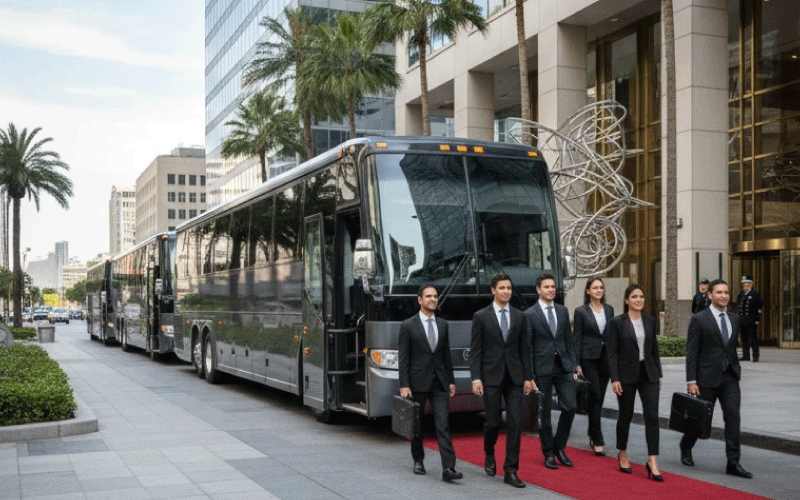
Transport is frequently the first physical touchpoint of a corporate event. Arriving together in a well-presented coach signals organisation and professionalism, reduces visible congestion at venues, creates a cohesive team presence, and supports premium event positioning. For organisations hosting clients, investors, or international guests, the experience begins before the meeting room door opens. Corporate coach hire reinforces a standard — one that reflects reliability, coordination, and control — from the moment the day starts.
4. Scale Changes the Equation
Transport for a small internal meeting is one thing. Managing travel for 80 staff members, a multi-day national conference, delegates arriving at different UK airports, or simultaneous events in multiple regions is something else entirely. At scale, transport becomes an operational system requiring capacity modelling, coordinated scheduling, centralised communication, and contingency planning. This is where nationwide coach hire management provides measurable value. Rather than booking city by city, organisations work with one partner who delivers consistent fleet standards, unified reporting, centralised invoicing, and national coordination. That is strategic efficiency.
5. Financial Clarity and Cost Control
A purely transactional booking approach can hide long-term inefficiencies: duplicate bookings, last-minute price surges, poor capacity utilisation, and overtime costs caused by poor scheduling. Managed transport solutions introduce transparent pricing, accurate forecasting, optimised vehicle allocation, and reduced administrative overhead. When transport is planned strategically, it becomes predictable — and predictability protects budgets. Finance and operations leaders gain the clarity they need to plan accurately and identify further savings across the full travel programme.
6. Technology and Real-Time Accuracy
Manual spreadsheets and disconnected email threads create friction and risk, especially for larger events. System-driven transport management — such as the eCoach Manager platform — means quotes reflect real-time availability, capacity changes are tracked accurately, schedules are centralised, and operational teams have visibility across all movements. For corporate planners, this means fewer surprises, greater cost certainty, and faster adjustments when plans evolve. Technology removes guesswork and introduces control — a hallmark of strategic decision-making.
7. Duty of Care and Employee Wellbeing
Corporate responsibility extends beyond the boardroom. Providing organised group transport reduces travel stress, minimises exposure to unpredictable conditions, ensures safe arrival during late evening functions, and supports wellbeing during intensive conference days. In winter months particularly, when weather and daylight conditions add complexity to UK travel, a structured coach hire plan ensures safe, coordinated movement regardless of what the day brings.
8. Sustainability as a Strategic Lever
Environmental accountability is now embedded in corporate reporting and ESG frameworks. Coach hire offers reduced per-person emissions, fewer vehicles on the road, and simplified carbon reporting. Organisations serious about sustainability can align transport strategy directly with their environmental commitments — rather than treating travel as an afterthought when sustainability goals are reviewed. One coach replacing dozens of individual cars is a tangible, reportable contribution to Scope 3 emissions reduction.
9. Simplifying Multi-City Operations
For organisations operating nationally, travel is rarely confined to one location. A leadership programme may begin in London, continue in Birmingham, and conclude in Manchester. Without a coordinated transport partner, each location introduces new suppliers, new contracts, and inconsistent standards. A nationwide coach hire partner eliminates this fragmentation by delivering unified service levels, centralised planning, consistent fleet quality, and 24/7 support across all regions. Strategic consistency replaces operational patchwork.
10. 24/7 Support: Strategy in Action
Corporate events rarely follow a predictable script. Flights are delayed. Agendas shift. Attendee numbers change. Evening networking extends longer than planned. Having 24/7 operational support means immediate issue resolution, real-time coordination, direct driver communication, and clear accountability at every hour of the day. This is not a luxury — it is risk mitigation in action, and it is what separates a managed transport partner from a transactional booking platform.
Why Leading Organisations Choose a Managed Transport Partner
Forward-looking businesses choose a transport partner on the basis of the following qualities — and the best providers deliver on all of them consistently.
- Corporate-Focused Expertise: Deep understanding of executive travel requirements, event logistics, and the governance expectations that come with moving senior stakeholders.
- National Coverage: Consistent service across London, Birmingham, Manchester, and every region in between — with no need to source and vet local suppliers in each new location.
- Consistent Fleet Standards: Modern, well-presented executive vehicles that reflect the calibre of the organisation at every touchpoint.
- Technology-Driven Coordination: Real-time scheduling, accurate capacity management, and centralised visibility for corporate planners throughout the event.
- 24/7 Operational Resilience: Round-the-clock support that resolves issues immediately, regardless of when or where they arise during the event.
Frequently Asked Questions
Why is corporate coach hire considered a strategic decision?
Because it directly affects performance, perception, risk, and cost — all of which are strategic concerns. When managed proactively, transport protects organisational credibility, preserves productive time, and enables consistent, scalable operations across multiple UK locations.
How does managed transport reduce risk for corporate organisations?
A managed transport partner provides verified operators, compliant vehicles, experienced drivers, structured scheduling, clear communication, and 24/7 support. This reduces duty-of-care risk, reputational exposure, and the likelihood of disruption during high-stakes events — replacing reactive problem-solving with proactive governance.
How does corporate coach hire support ESG and sustainability goals?
Coach hire significantly reduces per-person emissions, puts fewer vehicles on the road, and simplifies carbon reporting for Scope 3 purposes. Organisations can align transport strategy directly with their environmental commitments rather than treating travel as a sustainability afterthought.
What is the difference between transactional and strategic transport management?
Transactional transport asks whether people can get to their destination. Strategic transport asks how that movement can enhance performance, protect reputation, and support long-term objectives. A managed transport solution answers the second question — through foresight, coordination, technology, and nationwide consistency.
Conclusion: Elevating Transport to the Strategic Agenda
When transport runs flawlessly, it often goes unnoticed. When it fails, it dominates attention. The most successful organisations recognise that time is a strategic resource, risk must be mitigated, brand perception matters, scale requires coordination, and technology enables control. Corporate coach hire, delivered as a managed transport solution, is therefore not simply about moving people. It is about protecting reputation, preserving productivity, and enabling performance. By partnering with The Coach Company UK, your organisation moves transport from the bottom of the planning agenda to where it belongs — as a strategic asset that supports every goal you set.
Corporate & Business Transport: +44 330 124 4301
General Inquiries: +44 330 174 0598
Email: info@thecoachcompany.com
Visit thecoachcompany.co.uk and complete our Quote Form today.